
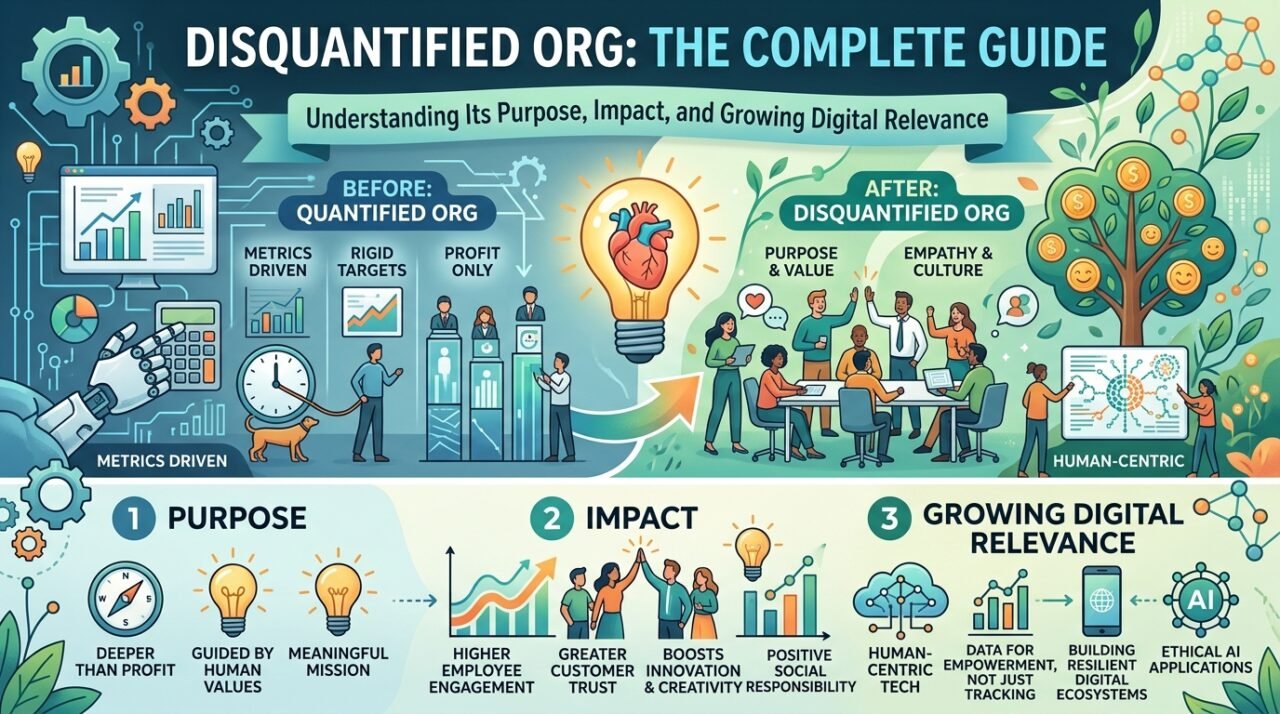

Digital transformation continues to reshape how people evaluate information, organizations, and technological systems. As new concepts emerge, disquantified org has become an increasingly discussed term among professionals interested in digital innovation, knowledge management, organizational transparency, and data interpretation. Although the concept is still developing, it reflects a broader movement toward balancing measurable analytics with qualitative insight.
Understanding disquantified org requires looking beyond traditional metrics. Organizations, researchers, and digital strategists increasingly recognize that numbers alone rarely tell the complete story. Human experience, context, collaboration, and long-term value all influence successful decision-making, making this topic highly relevant for modern businesses and knowledge-driven communities.
What Is Disquantified Org?
At its core, disquantified org represents an approach that encourages looking beyond purely numerical performance indicators. Rather than rejecting data, it promotes combining measurable outcomes with qualitative evaluation to produce a more complete understanding of organizational performance and digital ecosystems.
This perspective is increasingly valuable because many strategic decisions involve creativity, trust, collaboration, customer experience, and innovation—areas that cannot always be accurately represented by spreadsheets alone. As organizations mature digitally, balanced evaluation becomes an essential competitive advantage.
Why Disquantified Org Matters Today
Modern organizations collect enormous volumes of information every day. While analytics platforms generate valuable reports, they often overlook human factors that influence productivity, customer satisfaction, and sustainable growth. Disquantified org helps bridge this gap by encouraging broader evaluation methods.
Businesses operating in competitive markets benefit when leaders interpret metrics alongside employee feedback, customer behavior, market context, and operational realities. This combination supports more informed decisions while reducing the risk of relying exclusively on isolated performance indicators.
Core Principles Behind Disquantified Org
Several foundational ideas define the philosophy behind disquantified org. These include contextual decision-making, balanced analysis, continuous learning, transparency, collaboration, and responsible interpretation of information rather than blind dependence on numerical benchmarks.
Another important principle involves recognizing uncertainty. Real-world situations rarely fit perfectly into predefined categories, making flexibility essential. By acknowledging complexity instead of oversimplifying it, organizations can create strategies that remain resilient even when circumstances rapidly change.
Key Characteristics Compared
The following comparison highlights how traditional measurement approaches differ from the broader perspective encouraged by disquantified org.
| Traditional Measurement | Disquantified Org Perspective | Practical Benefit |
|---|---|---|
| Focuses primarily on numbers | Combines quantitative and qualitative insight | More balanced decisions |
| Measures short-term performance | Evaluates long-term sustainability | Better strategic planning |
| Prioritizes efficiency metrics | Includes collaboration and innovation | Stronger organizational culture |
| Uses standardized benchmarks | Considers context and unique situations | More accurate interpretation |
| Relies heavily on reports | Encourages discussion and reflection | Improved leadership decisions |
| Measures outputs | Evaluates outcomes and broader impact | Greater long-term value |
This comparison demonstrates that disquantified org does not eliminate analytics. Instead, it expands analytical thinking by incorporating additional dimensions that traditional reporting frequently overlooks.
Practical Applications Across Industries
Organizations across technology, education, healthcare, consulting, nonprofit management, and digital services can apply disquantified org principles to improve strategic planning. Decision-makers gain deeper insight by evaluating both measurable outcomes and less tangible organizational strengths.
For example, a software company may exceed revenue targets while experiencing declining employee engagement. Standard reports may indicate success, but broader evaluation reveals risks that could eventually affect innovation, customer satisfaction, and talent retention.
Benefits of Adopting Disquantified Org
One major advantage of disquantified org is improved decision quality. Leaders gain a fuller understanding of complex situations by combining statistical evidence with practical experience, stakeholder perspectives, and contextual awareness.
Another benefit involves stronger organizational resilience. Companies that appreciate qualitative insights often identify emerging opportunities and hidden risks earlier than competitors focused exclusively on performance dashboards and numerical targets.
Common Misconceptions
Some people mistakenly assume disquantified org encourages ignoring data altogether. In reality, the opposite is true. The concept values data while emphasizing that numbers should support—not replace—critical thinking and human judgment.
Another misconception suggests qualitative evaluation lacks reliability. When structured properly through interviews, observation, expert analysis, and documented feedback, qualitative information becomes a powerful complement to traditional analytics and strengthens evidence-based decision-making.
Building a Balanced Decision Framework
Organizations interested in disquantified org typically begin by reviewing how decisions are currently made. Many discover that key performance indicators dominate conversations while customer experiences, employee perspectives, and operational context receive less attention.
A balanced framework introduces multiple evaluation dimensions. Financial performance remains important, but it is considered alongside innovation capacity, organizational culture, customer trust, adaptability, and long-term strategic positioning to support sustainable growth.
Technology and the Future of Disquantified Org
Artificial intelligence, predictive analytics, and automation continue expanding organizational access to data. Ironically, these technological advances make disquantified org even more valuable because human interpretation becomes increasingly important when information volumes grow exponentially.
Future digital ecosystems will likely combine advanced analytics with ethical reasoning, contextual awareness, and interdisciplinary collaboration. Organizations capable of integrating both measurable evidence and qualitative insight will likely outperform those relying exclusively on algorithmic recommendations.
Best Practices for Successful Implementation
Successful adoption of disquantified org begins with leadership commitment. Executives should encourage cross-functional discussions where numerical reports are supplemented by customer stories, employee experiences, expert observations, and market intelligence.
Organizations should also establish regular review processes that evaluate strategic assumptions instead of merely reviewing performance metrics. This habit encourages continuous learning while improving organizational adaptability in rapidly changing environments.
Expert Perspective
An often-cited leadership principle captures the essence of balanced evaluation:
“Not everything that counts can be counted, and not everything that can be counted counts.”
This insight reminds decision-makers that meaningful organizational success depends on understanding both measurable performance and the broader human context surrounding every strategic decision.
Conclusion
The growing relevance of disquantified org reflects an important shift in modern organizational thinking. Rather than abandoning measurement, it encourages more intelligent interpretation by combining quantitative analysis with qualitative understanding, contextual awareness, and practical expertise.
As businesses, institutions, and digital communities continue navigating increasingly complex environments, balanced decision-making will become a defining competitive advantage. Organizations embracing disquantified org are better positioned to recognize hidden opportunities, strengthen resilience, improve collaboration, and create sustainable long-term value beyond traditional performance metrics.
FAQ
What is disquantified org?
Disquantified org is an approach that combines quantitative measurement with qualitative evaluation to support more balanced, informed organizational decision-making.
Why is disquantified org becoming more relevant?
As organizations generate larger amounts of data, disquantified org helps leaders interpret information within real-world context instead of relying solely on numerical indicators.
Does disquantified org reject data analytics?
No. Disquantified org values analytics while encouraging organizations to combine measurable evidence with human insight, experience, and contextual understanding.
Which industries can benefit from disquantified org?
Technology, education, healthcare, consulting, nonprofit organizations, finance, marketing, and many other sectors can apply disquantified org principles to improve strategic decisions.
How can organizations implement disquantified org?
Organizations can adopt disquantified org by balancing key performance indicators with customer feedback, employee insights, qualitative research, expert judgment, and continuous strategic evaluation.
Is disquantified org useful for small businesses?
Yes. Small businesses can use disquantified org to make smarter decisions by considering customer relationships, team collaboration, local market conditions, and long-term business sustainability alongside traditional financial metrics.
Read More: Wallpostmedia Com: A Complete Guide to Digital Growth and Content Marketing Excellence