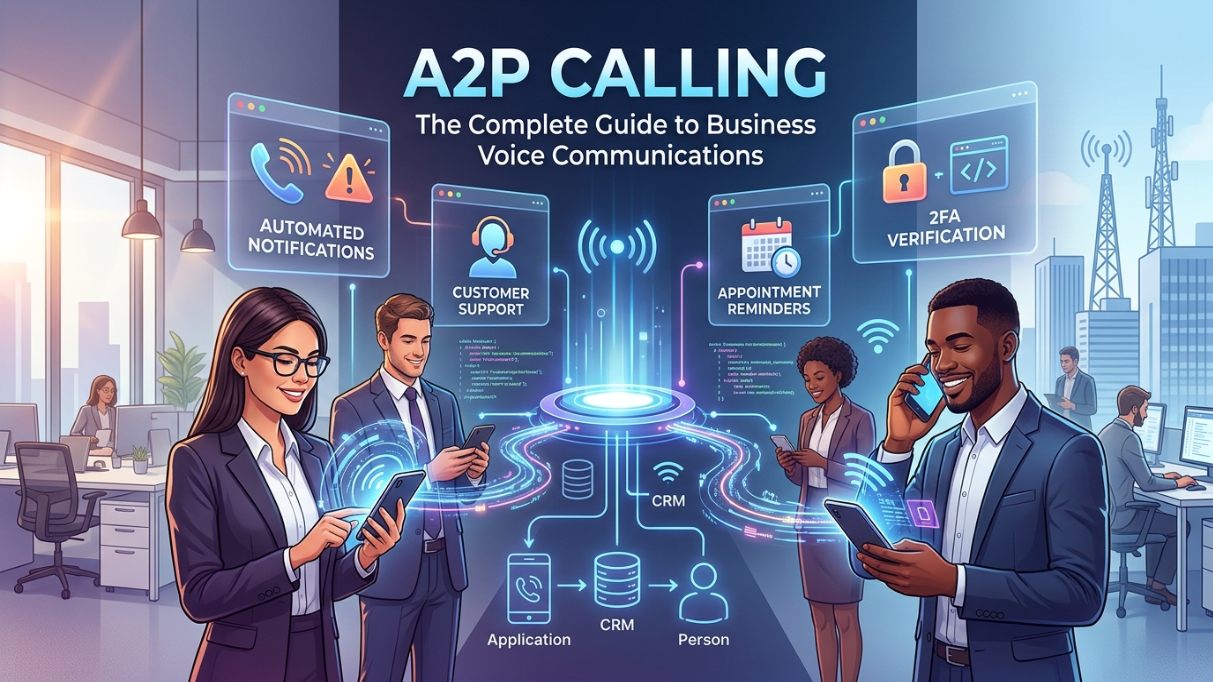

Businesses today need communication methods that are fast, secure, and scalable. Customers expect instant updates, appointment reminders, authentication calls, and personalized interactions without delays. This growing demand has made a2p calling one of the most valuable communication technologies for organizations across industries.
Unlike traditional person-to-person calls, a2p calling enables automated voice communication from applications directly to customers. Whether confirming a delivery, sending fraud alerts, verifying identities, or notifying patients about appointments, businesses can reach thousands of users efficiently while maintaining a professional customer experience. Understanding how this technology works can help organizations improve engagement, strengthen trust, and streamline communication strategies.
What Is A2P Calling?
A2P calling stands for Application-to-Person calling, a communication method where software applications automatically place voice calls to individuals. These calls are generated through cloud communication platforms or APIs rather than manually initiated by employees.
Organizations use this technology for time-sensitive notifications, verification codes, emergency announcements, payment reminders, customer support updates, and marketing campaigns. Because calls are automated, businesses can communicate consistently while reducing operational costs and minimizing human error.
How A2P Calling Works
At its core, a2p calling connects business applications with telecom networks using programmable voice APIs. A business platform triggers a call based on predefined events, customer actions, or scheduling rules, allowing information to reach recipients almost instantly.
The process typically involves customer data, automation logic, cloud telephony infrastructure, and intelligent routing systems. Modern platforms also provide analytics, delivery reporting, speech synthesis, call recording, and interactive voice response (IVR) capabilities to enhance communication efficiency.
Why Businesses Are Adopting A2P Calling
Organizations increasingly rely on digital communication, and customers expect timely interactions across multiple channels. A2P calling bridges this gap by delivering important voice messages without requiring agents to manually place every call.
The technology also improves scalability. Whether contacting one hundred customers or one million, businesses can automate communication while maintaining message consistency, reducing response times, and supporting better customer experiences across different markets.
Common Business Use Cases
Many industries depend on automated voice communication for mission-critical operations. Healthcare providers send appointment reminders, banks deliver fraud alerts, retailers confirm deliveries, airlines announce schedule changes, and educational institutions notify students about important events.
Customer support teams also benefit from a2p calling by automating callback notifications, queue updates, and satisfaction surveys. This reduces workload for support staff while ensuring customers remain informed throughout their journey.
A2P Calling vs Traditional Business Calls
Understanding the difference between automated and manual communication helps organizations choose the right solution for their operational needs. While both approaches serve valuable purposes, automation offers significant advantages for repetitive, high-volume interactions.
| Feature | A2P Calling | Traditional Business Calls |
|---|---|---|
| Call Initiation | Automated by applications | Manually initiated by staff |
| Scalability | Very high | Limited by workforce |
| Speed | Instant | Depends on agent availability |
| Personalization | Dynamic using customer data | Manual personalization |
| Cost Efficiency | Lower for large volumes | Higher labor costs |
| Analytics | Extensive reporting | Limited tracking |
| Availability | 24/7 automation | Business hours dependent |
| Common Uses | Alerts, reminders, verification | Sales, consultation, support |
Businesses often combine both methods, using automation for routine communication while reserving human conversations for complex customer interactions that require empathy and detailed problem solving.
Security and Compliance Considerations
Security is one of the strongest advantages of a2p calling when implemented correctly. Many organizations use encrypted communication channels, authenticated APIs, caller verification, and access controls to protect sensitive customer information throughout the calling process.
Regulatory compliance is equally important. Businesses should obtain customer consent, respect regional telecommunications regulations, maintain accurate call records, and provide opt-out mechanisms where required. Following these practices builds trust while reducing legal and reputational risks.
“Automation should enhance human communication, not replace trust. Secure, transparent customer interactions create lasting business relationships.”
Key Benefits of A2P Calling
One of the greatest strengths of a2p calling is operational efficiency. Automated systems eliminate repetitive manual tasks, allowing employees to focus on higher-value customer interactions while maintaining consistent communication standards across every campaign.
The technology also improves customer satisfaction through immediate notifications, faster response times, higher message delivery rates, and personalized voice interactions. Combined with analytics, businesses gain valuable insights that help optimize future communication strategies.
Best Practices for Successful Implementation
Successful deployment begins with clearly defining communication goals. Organizations should identify which customer interactions benefit from automation, create concise voice scripts, schedule calls appropriately, and continuously monitor performance metrics for ongoing improvements.
Businesses should also integrate a2p calling with CRM platforms, marketing automation tools, and customer support systems. This creates a unified communication ecosystem where customer information remains synchronized across multiple channels.
Challenges Businesses Should Understand
Although automation offers significant advantages, organizations should avoid excessive or poorly timed calls. Frequent interruptions can negatively affect customer perception and reduce engagement, even when the information being delivered is valuable.
Another challenge involves maintaining accurate customer databases. Incorrect contact information, outdated preferences, or inconsistent records reduce campaign effectiveness. Regular database maintenance and quality assurance are essential for maximizing communication success.
Future Trends in A2P Calling
Artificial intelligence is rapidly transforming automated voice communications. Advanced speech synthesis, natural language processing, predictive analytics, and conversational AI are making a2p calling more personalized, intelligent, and responsive than ever before.
Businesses are also embracing omnichannel communication strategies that combine automated voice calls with SMS, email, messaging apps, and customer portals. This integrated approach creates seamless customer experiences while improving engagement across every stage of the customer journey.
Conclusion
As customer expectations continue to evolve, businesses require communication solutions that are reliable, scalable, and secure. A2P calling delivers these capabilities by automating voice interactions while maintaining consistency, improving operational efficiency, and supporting better customer experiences across industries.
Organizations that implement thoughtful automation strategies, prioritize customer consent, and continuously optimize performance can transform voice communication into a competitive advantage. Rather than replacing human interaction, a2p calling enhances it by ensuring the right information reaches the right person at exactly the right time.
FAQ
What is a2p calling?
A2P calling is an automated voice communication method where software applications place calls directly to customers for notifications, authentication, reminders, alerts, and other business purposes.
Is a2p calling secure?
Yes. Modern a2p calling platforms use encryption, authentication, secure APIs, and compliance measures to protect customer data and support secure communications.
Which industries benefit most from a2p calling?
Healthcare, banking, retail, logistics, education, travel, insurance, telecommunications, and government organizations commonly use a2p calling for high-volume customer communication.
Can small businesses use a2p calling?
Absolutely. Cloud-based communication platforms have made a2p calling accessible to businesses of every size, allowing small organizations to automate customer interactions without significant infrastructure investments.
How does a2p calling improve customer experience?
A2P calling delivers timely information, reduces waiting times, automates important notifications, improves communication consistency, and helps customers stay informed through reliable voice interactions.
Can a2p calling integrate with CRM systems?
Yes. Most modern communication platforms integrate with CRM software, customer service platforms, marketing automation tools, and business applications to create personalized and efficient communication workflows.