
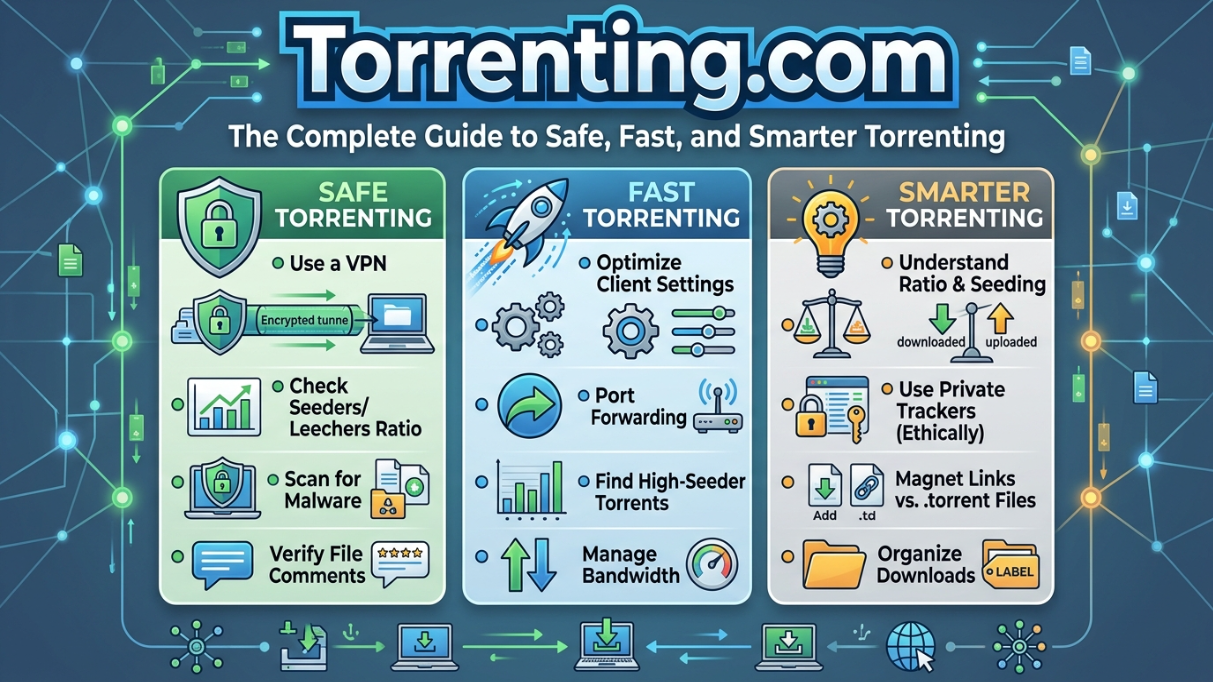

Torrent technology has transformed the way large files are shared across the internet. Rather than relying on a single download server, peer-to-peer networking distributes data efficiently among users, making downloads faster, more resilient, and often more reliable. As interest in decentralized file sharing continues to grow, torrenting.com has become a recognizable keyword for users seeking information, resources, and practical guidance about torrenting.
Whether you are new to peer-to-peer networking or looking to improve your understanding of advanced torrenting practices, this guide explores the technology, security considerations, performance optimization, and responsible usage. The goal is to provide practical knowledge that helps users make informed decisions while navigating today’s digital landscape.
Understanding Torrenting.com
Torrenting is a method of sharing files using peer-to-peer (P2P) technology rather than downloading content directly from a centralized server. Instead of one source delivering an entire file, many users contribute small pieces simultaneously, improving speed and reducing server dependency. The keyword torrenting.com often represents searches related to this ecosystem, educational resources, and best practices.
The underlying technology depends on torrent files or magnet links, trackers, and participating peers known as seeders and leechers. When enough seeders remain available, downloads become faster and more reliable. This decentralized approach has made torrenting an enduring component of modern internet infrastructure.
How Torrenting Technology Works
Every torrent begins with metadata that identifies the shared content without containing the file itself. Once a compatible torrent client opens this information, it connects to available peers and downloads numerous pieces simultaneously before assembling the complete file on the user’s device.
This distributed architecture reduces bottlenecks commonly found with traditional downloads. torrenting.com is frequently associated with learning how this process operates, including concepts such as swarm participation, bandwidth allocation, piece verification, and distributed hash tables that improve peer discovery.
Why Torrenting Remains Popular
Peer-to-peer distribution provides significant efficiency when transferring large files. Open-source software projects, Linux distributions, research archives, educational materials, and public datasets often use torrent technology because it minimizes hosting costs while improving download reliability for global audiences.
Another reason for continued popularity is scalability. As more users share legitimate content, additional upload capacity naturally becomes available. This network effect allows torrenting.com to remain relevant among individuals researching decentralized file distribution and internet infrastructure.
Security Considerations for Torrent Users
Security should always be a priority when downloading files through peer-to-peer networks. Users should verify file authenticity, avoid suspicious downloads, maintain updated antivirus software, and carefully review comments or reputation indicators whenever available before opening downloaded files.
Privacy is equally important because peer connections expose IP addresses during participation in a torrent swarm. Many experienced users researching torrenting.com also study encryption, VPN usage, secure torrent clients, firewall settings, and safe downloading habits that reduce unnecessary exposure.
Legal and Ethical Responsibilities
Torrent technology itself is completely legal because it is simply a method of transferring digital data efficiently. Numerous organizations distribute open-source software, academic publications, government datasets, and public-domain media through torrents because of the technology’s scalability and cost-effectiveness.
Legal issues arise when copyrighted material is shared without proper authorization. Understanding applicable copyright laws, licensing agreements, and regional regulations helps users employ torrenting.com responsibly while respecting intellectual property rights and supporting legitimate creators.
Choosing the Right Torrent Client
Selecting a reliable torrent client significantly influences download performance, security, and overall user experience. Good clients prioritize stable connections, efficient bandwidth management, encryption support, scheduling options, and active development to address evolving security concerns.
Many experienced users evaluating torrenting.com compare software based on interface simplicity, resource consumption, update frequency, plugin availability, and privacy-focused features. A trustworthy client should balance functionality with transparency and long-term maintenance.
Optimizing Download Performance
Download speeds depend on several interconnected variables rather than internet bandwidth alone. Seeder availability, peer quality, upload contribution, network congestion, client configuration, and router settings all influence the efficiency of a torrent transfer.
Users interested in torrenting.com often improve performance by choosing healthy torrents with strong seeder-to-leecher ratios, enabling protocol encryption, configuring proper port forwarding when appropriate, and limiting unnecessary background network activity during downloads.
Comparison of Key Torrenting Factors
| Factor | Why It Matters | Best Practice | Potential Risk |
|---|---|---|---|
| Seeder Count | Improves download speed | Choose torrents with many seeders | Slow downloads |
| Torrent Client | Affects stability and security | Use reputable, updated software | Vulnerabilities |
| VPN Usage | Enhances privacy | Select a trustworthy VPN provider | Reduced privacy without protection |
| File Verification | Prevents corruption | Verify checksums when available | Damaged or altered files |
| Antivirus Protection | Detects malicious software | Keep definitions updated | Malware infection |
| Legal Source | Ensures compliance | Download authorized content | Copyright infringement |
| Upload Ratio | Supports network health | Continue seeding responsibly | Poor swarm performance |
Best Practices for Responsible Torrenting
Responsible torrenting combines technical knowledge with ethical decision-making. Verifying sources, downloading authorized material, maintaining secure devices, and understanding regional regulations create a safer environment for everyone participating in peer-to-peer networks.
Long-term users searching for torrenting.com also recognize the value of contributing back to healthy swarms by seeding completed downloads when appropriate. This cooperative model strengthens decentralized distribution while supporting legitimate projects that depend on community participation.
Common Misconceptions About Torrenting
Many people incorrectly assume that torrenting always involves illegal activity. In reality, countless organizations distribute perfectly legitimate software, educational resources, creative commons media, and scientific datasets using peer-to-peer technology because it is efficient and economical.
Another misconception is that torrenting automatically compromises security. While risks certainly exist, careful file verification, updated security software, privacy awareness, and responsible behavior significantly reduce exposure. Understanding these distinctions helps users approach torrenting.com with greater confidence and informed expectations.
Future Trends in Peer-to-Peer File Sharing
Peer-to-peer networking continues evolving alongside improvements in internet infrastructure, distributed computing, and decentralized technologies. Enhanced encryption, smarter peer discovery, improved bandwidth optimization, and greater interoperability are expected to strengthen future torrent ecosystems.
As digital collaboration expands globally, torrenting.com will likely remain relevant for users exploring efficient file distribution methods. Organizations increasingly recognize that decentralized delivery can reduce operational costs while improving accessibility for large audiences across different geographic regions.
Expert Perspective
“Technology is most valuable when users understand both its capabilities and their responsibilities.”
This principle perfectly reflects the role of torrent technology in today’s internet. torrenting.com represents more than downloading files—it symbolizes learning how decentralized systems operate safely, ethically, and efficiently while respecting digital rights and maintaining strong cybersecurity practices.
Conclusion
Torrent technology remains one of the internet’s most effective methods for distributing large files through decentralized peer-to-peer networking. When used responsibly, it offers impressive scalability, efficient bandwidth utilization, and dependable access to legitimate digital resources ranging from open-source software to educational materials.
Understanding security practices, selecting reliable software, respecting copyright laws, and maintaining good digital hygiene are essential for every user. Whether you are exploring torrenting for the first time or expanding your technical knowledge, torrenting.com serves as a valuable starting point for understanding responsible, efficient, and informed peer-to-peer file sharing.
FAQ
What is torrenting.com?
torrenting.com refers to a commonly searched term related to torrent technology, peer-to-peer file sharing, educational resources, and guidance for responsible torrent usage.
Is torrenting legal?
Torrenting itself is legal because it is simply a file transfer method. Legality depends on whether the shared content is authorized for distribution.
How can I stay safe while using torrenting.com?
Use trusted torrent clients, keep antivirus software updated, verify downloaded files, and prioritize privacy and security best practices whenever participating in peer-to-peer networks.
Why are some torrents faster than others?
Download speed depends on factors including the number of seeders, peer quality, internet connection stability, client configuration, and overall swarm health.
Can torrenting.com help beginners understand torrent technology?
Yes. Users searching for torrenting.com typically seek educational information about torrent fundamentals, security practices, performance optimization, legal considerations, and responsible peer-to-peer file sharing.
Read More: https://blogzentro.co.uk/tipnitop-com/