
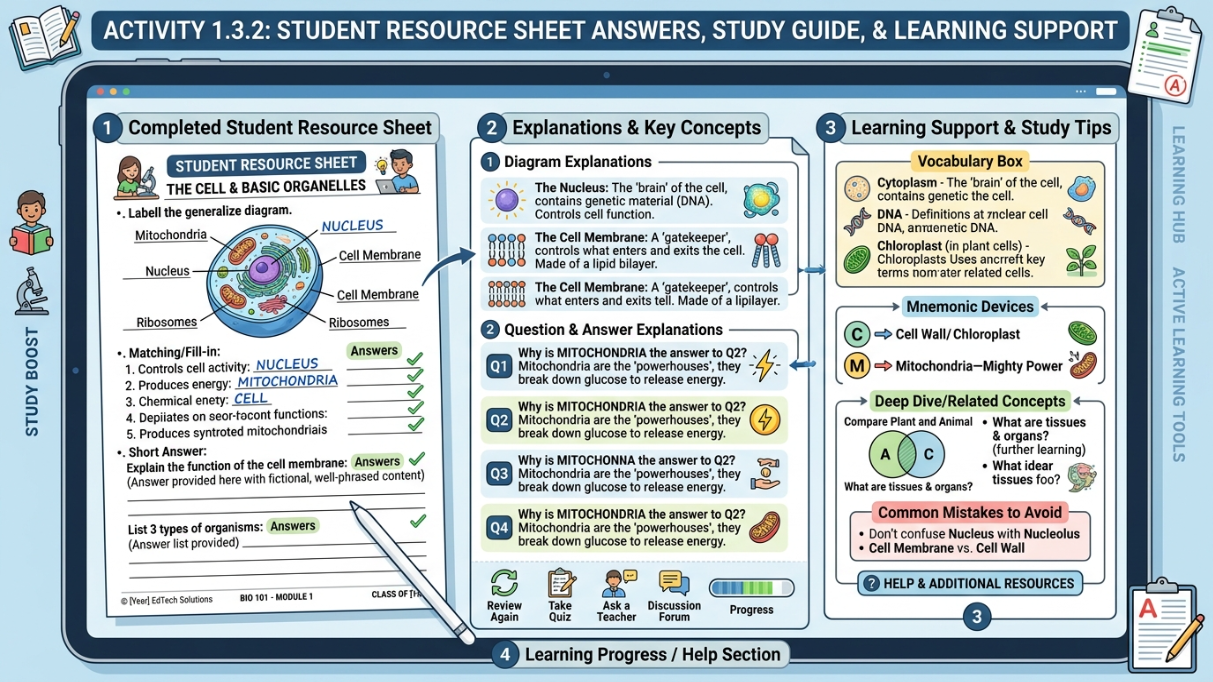

Finding reliable activity 1.3.2 student resource sheet answers can save time, strengthen understanding, and help students prepare more effectively for assignments and assessments. While many learners search for direct answers, the greatest academic benefit comes from understanding the reasoning behind each response and applying those concepts confidently.
This guide explains how activity 1.3.2 student resource sheet answers should be used as learning tools rather than simple answer keys. You’ll discover practical study methods, common mistakes to avoid, and strategies that promote long-term academic success while improving comprehension across related classroom activities.
Understanding Activity 1.3.2 Student Resource Sheet Answers
The purpose of activity 1.3.2 student resource sheet answers extends beyond completing homework. These resources help students verify their thinking, identify knowledge gaps, and understand how classroom concepts connect with real educational objectives.
Rather than memorizing solutions, learners should compare their own responses with activity 1.3.2 student resource sheet answers to recognize patterns, improve reasoning, and build confidence before quizzes, projects, or examinations.
Why Students Search for These Answers
Students often seek activity 1.3.2 student resource sheet answers when reviewing assignments independently or preparing for classroom discussions. Reliable explanations provide reassurance while reinforcing concepts that may have seemed confusing during lessons.
Parents, tutors, and educators also benefit from accurate reference material because it enables productive conversations about learning instead of simply focusing on whether an answer is correct or incorrect.
How to Use Answer Sheets Effectively
The most effective approach is to complete every question independently before checking activity 1.3.2 student resource sheet answers. This process strengthens critical thinking and highlights areas that deserve additional review.
Once comparisons are complete, students should rewrite incorrect responses in their own words. Transforming mistakes into personalized explanations significantly improves retention and encourages deeper understanding of the underlying concepts.
Key Benefits of Using Student Resource Sheets
Well-prepared resource sheets reduce uncertainty and provide structured guidance during revision. They also encourage consistent study habits by giving learners a reliable benchmark against which they can measure progress.
When combined with classroom notes, textbooks, and teacher feedback, activity 1.3.2 student resource sheet answers become valuable revision tools that support stronger academic performance rather than replacing genuine learning.
Common Mistakes Students Should Avoid
Many learners immediately copy activity 1.3.2 student resource sheet answers without attempting the activity themselves. Although this may save time temporarily, it limits problem-solving ability and weakens long-term knowledge retention.
Another frequent mistake is ignoring explanations behind the answers. Understanding why a response is correct is often more valuable than simply recognizing the correct choice, particularly when similar questions appear later.
Comparison of Study Approaches
The way students use educational resources has a direct impact on learning outcomes. The following comparison illustrates the difference between productive study habits and passive answer copying.
| Study Method | Short-Term Result | Long-Term Learning | Exam Preparation | Confidence Level |
|---|---|---|---|---|
| Copying answers directly | Fast completion | Low retention | Weak | Low |
| Reviewing explanations | Moderate progress | Strong understanding | Good | High |
| Solving first, then checking answers | Excellent accuracy | Excellent retention | Excellent | Very High |
| Discussing answers with teachers | Deeper insight | Outstanding comprehension | Excellent | Very High |
Students who treat activity 1.3.2 student resource sheet answers as learning references consistently develop stronger analytical skills than those who rely solely on copying completed work.
Practical Learning Strategies
A productive revision session begins by reading each question carefully before attempting a solution. Afterward, compare your work with activity 1.3.2 student resource sheet answers, identifying both strengths and areas that need additional practice.
Creating summary notes from corrected mistakes is another highly effective technique. Short personalized explanations help reinforce understanding while making future revision sessions faster and more organized.
Supporting Independent Learning
Independent learners benefit from structured resources because they provide immediate feedback without requiring constant teacher supervision. This encourages responsibility and builds confidence in solving unfamiliar problems.
Educational research consistently shows that self-assessment strengthens memory. As educational psychologist John Hattie observed, “The biggest effects on student learning occur when learners become their own teachers.” This principle explains why thoughtfully reviewing activity 1.3.2 student resource sheet answers can be far more effective than passive memorization.
Choosing Reliable Answer Resources
Not every online answer sheet provides accurate or complete information. Students should prioritize resources that explain concepts clearly, align with classroom objectives, and encourage genuine understanding rather than shortcut solutions.
High-quality activity 1.3.2 student resource sheet answers typically include contextual explanations, examples, and opportunities for self-reflection. These features improve comprehension while supporting responsible academic practices.
Building Better Study Habits
Consistent study routines produce better outcomes than last-minute cramming. Setting aside dedicated review sessions each week allows students to revisit completed activities, identify recurring mistakes, and steadily improve performance.
Pairing activity 1.3.2 student resource sheet answers with active recall, spaced repetition, and teacher feedback creates a balanced learning strategy that promotes both academic achievement and long-term subject mastery.
Conclusion
Searching for activity 1.3.2 student resource sheet answers is most valuable when the goal is learning rather than simply completing an assignment. Students who actively compare their work, study explanations, and reflect on mistakes gain deeper understanding and stronger academic confidence.
Ultimately, answer sheets work best as educational companions instead of replacements for independent thinking. By combining reliable resources with consistent study habits, learners can improve comprehension, perform better on assessments, and develop skills that extend far beyond a single classroom activity.
FAQ
What are activity 1.3.2 student resource sheet answers?
Activity 1.3.2 student resource sheet answers are reference solutions designed to help students review completed work, verify accuracy, and better understand the concepts covered in the activity.
Should I copy activity 1.3.2 student resource sheet answers?
No. The best approach is to attempt every question independently before reviewing activity 1.3.2 student resource sheet answers to identify mistakes and improve understanding.
Why are explanations more important than the answers?
Explanations teach the reasoning behind each response, making it easier to solve similar questions in future assignments and examinations while improving overall comprehension.
Where can I find reliable activity 1.3.2 student resource sheet answers?
Look for educational resources provided by teachers, schools, official learning platforms, or trusted academic websites that prioritize explanations instead of simple answer lists.
How can activity 1.3.2 student resource sheet answers improve exam preparation?
Using activity 1.3.2 student resource sheet answers for self-assessment helps students recognize weak areas, reinforce correct concepts, and build confidence through consistent review before exams.
Read More: Marilyn June Hawley: A Comprehensive Guide to Her Life, Legacy, and Public Interest