
Organizations evaluating enterprise software rarely focus on price alone. They want scalability, security, predictable costs, implementation support, and a platform that continues delivering value as business requirements evolve. Understanding test.com pricing enterprise plans requires looking beyond the monthly invoice and evaluating the complete investment.
This guide explains how enterprise pricing typically works, what influences costs, how organizations can evaluate value, and what decision-makers should consider before selecting an enterprise plan. Whether you are leading procurement, IT, operations, or executive strategy, this resource provides practical insights for making informed purchasing decisions.
Understanding Test.com Pricing Enterprise Plans
Enterprise software pricing differs significantly from consumer subscriptions because organizations require customized capabilities, contractual flexibility, and long-term scalability. Instead of fixed public pricing, many vendors structure enterprise agreements around business requirements, deployment complexity, and support expectations.
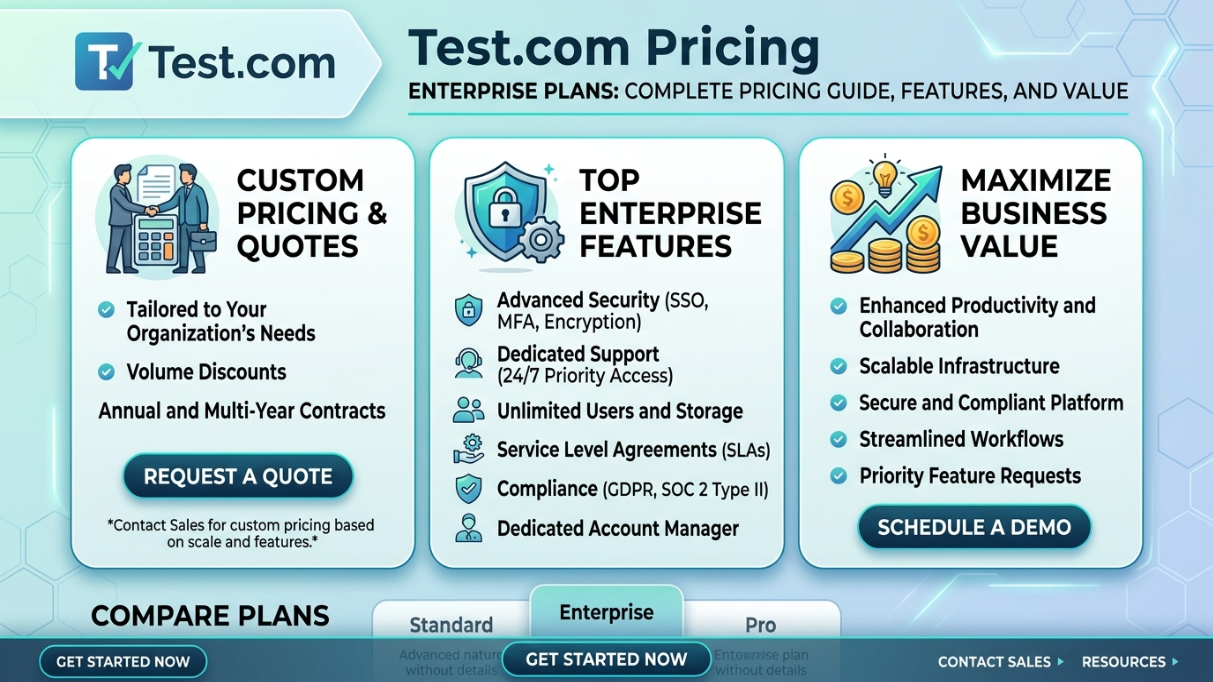
When evaluating test.com pricing enterprise plans, buyers should expect discussions around organization size, expected platform usage, compliance requirements, service-level agreements, onboarding assistance, and future expansion. These factors collectively shape the final enterprise proposal rather than a single universal price.
Why Enterprise Pricing Is Usually Customized
Every enterprise has different operational requirements. A multinational company managing thousands of employees naturally requires more infrastructure, integrations, and administrative controls than a regional organization with a few hundred users.
For that reason, test.com pricing enterprise plans are generally designed around business needs instead of rigid packages. Custom pricing enables organizations to pay for the capabilities that genuinely support their workflows without investing in unnecessary functionality.
Core Features Included in Enterprise Plans
Enterprise plans commonly extend well beyond standard software subscriptions. Advanced security controls, centralized administration, detailed reporting, API access, automation capabilities, identity management, and dedicated customer success resources are frequently included.
Organizations exploring test.com pricing enterprise plans should evaluate the complete feature ecosystem rather than comparing headline prices alone. A higher subscription cost often includes operational efficiencies that reduce administrative overhead across multiple departments.
Enterprise Feature Comparison
| Feature Category | Standard Plan | Professional Plan | Enterprise Plan |
|---|---|---|---|
| User Management | Basic | Advanced Roles | Enterprise Identity Controls |
| Security | Standard Authentication | Enhanced Security | Advanced Security, SSO, Compliance Controls |
| Reporting | Basic Dashboards | Custom Reports | Enterprise Analytics & Executive Dashboards |
| API Access | Limited | Expanded | Full Enterprise APIs |
| Integrations | Core Integrations | Extended Integrations | Custom Enterprise Integrations |
| Customer Support | Business Hours | Priority Support | Dedicated Success Team |
| SLA Availability | Standard | Enhanced | Enterprise SLA Options |
| Scalability | Moderate | High | Organization-Wide Deployment |
| Administrative Controls | Basic | Advanced | Granular Governance |
| Implementation Services | Self-Service | Assisted | Dedicated Enterprise Onboarding |
Factors That Influence Enterprise Pricing
Several variables determine enterprise software costs. User count remains important, but implementation complexity, storage requirements, support levels, data retention policies, integration requirements, and contractual commitments often carry equal weight.
Organizations reviewing test.com pricing enterprise plans should prepare internal estimates for anticipated growth over the next three to five years. Long-term planning helps negotiate agreements that remain cost-effective as business needs evolve.
Licensing Models Explained
Enterprise vendors commonly offer several licensing approaches. Some prioritize per-user licensing, while others focus on organization-wide access, usage-based billing, department licensing, or hybrid commercial models.
Understanding these licensing structures makes test.com pricing enterprise plans easier to evaluate because the lowest price is not always the lowest total cost of ownership. Selecting the appropriate licensing framework often produces larger savings than negotiating a small percentage discount.
Security and Compliance Considerations
Security investments represent one of the biggest distinctions between standard and enterprise offerings. Features such as single sign-on, multi-factor authentication, audit logging, encryption, administrative permissions, and compliance certifications contribute significant value.
Organizations assessing test.com pricing enterprise plans should compare security capabilities against internal governance requirements rather than viewing them as optional extras. Preventing operational risk frequently justifies enterprise investment independently of productivity improvements.
Implementation and Onboarding
Successful enterprise software adoption depends on implementation quality. Migration planning, administrator training, technical documentation, change management, and phased deployment strategies significantly influence long-term success.
When reviewing test.com pricing enterprise plans, implementation services deserve careful attention because effective onboarding often accelerates user adoption while reducing internal support requirements during deployment.
Integration with Existing Business Systems
Modern enterprises depend on interconnected software ecosystems. CRM platforms, ERP systems, HR software, analytics tools, communication platforms, identity providers, and business intelligence solutions all influence purchasing decisions.
Strong integration capabilities increase the value of test.com pricing enterprise plans because they reduce manual data entry, eliminate information silos, improve reporting accuracy, and support workflow automation across departments.
Measuring Return on Investment
Enterprise software should generate measurable business outcomes rather than simply replacing existing tools. Productivity gains, reduced operational costs, faster reporting, improved collaboration, stronger compliance, and lower administrative workloads all contribute to return on investment.
A comprehensive evaluation of test.com pricing enterprise plans should include projected efficiency improvements alongside licensing costs. Organizations frequently discover that operational savings outweigh subscription expenses over the life of the agreement.
“Price is what you pay. Value is what you get.” — Warren Buffett
This principle remains especially relevant for enterprise software procurement. Decision-makers benefit from evaluating long-term organizational value instead of concentrating exclusively on upfront subscription costs.
Negotiating Enterprise Agreements
Enterprise negotiations extend beyond discounts. Contract flexibility, renewal protections, implementation assistance, training resources, customer success engagement, service-level commitments, and future scalability all influence overall value.
Buyers discussing test.com pricing enterprise plans should approach negotiations strategically by identifying organizational priorities before commercial discussions begin. Well-defined requirements typically produce stronger agreements than focusing solely on headline pricing.
Common Misconceptions About Enterprise Pricing
One common misconception is that enterprise software is simply an expensive version of a standard subscription. In reality, enterprise offerings frequently include governance capabilities, automation, security, and operational support unavailable in lower-tier plans.
Another misunderstanding surrounding test.com pricing enterprise plans is that customized pricing lacks transparency. Custom proposals often reflect unique deployment requirements rather than arbitrary pricing, allowing organizations to purchase solutions aligned with actual business objectives.
Industry Trends Shaping Enterprise Pricing
Enterprise software purchasing increasingly emphasizes flexibility. Vendors continue expanding usage-based pricing, modular licensing, AI-powered automation, and scalable subscription structures that better accommodate changing organizational needs.
These developments influence test.com pricing enterprise plans by encouraging more personalized commercial models instead of rigid pricing tiers. Buyers now expect agreements that adapt alongside workforce growth, technology modernization, and evolving digital transformation initiatives.
Practical Evaluation Checklist
Imagine a global company preparing to replace multiple disconnected software systems with a unified enterprise platform. The procurement team initially focuses on subscription pricing before realizing implementation support, integration capabilities, executive reporting, and governance tools ultimately determine project success.
This scenario illustrates why organizations evaluating test.com pricing enterprise plans should compare operational outcomes rather than price alone. The most valuable enterprise investment consistently balances technology capabilities, support quality, scalability, security, and predictable long-term costs.
Conclusion
Selecting enterprise software represents a strategic business decision rather than a simple purchasing exercise. Organizations benefit from examining licensing flexibility, implementation quality, security, support, scalability, and measurable business outcomes together instead of evaluating price in isolation.
A thoughtful review of test.com pricing enterprise plans enables procurement teams, technology leaders, and executives to identify solutions that deliver sustainable operational value. By considering total cost of ownership, future growth, integration capabilities, and organizational objectives, businesses can make confident enterprise investment decisions that support long-term success.
FAQ
What are test.com pricing enterprise plans?
Test.com pricing enterprise plans generally refer to customized enterprise subscriptions designed around organizational requirements, including users, features, implementation, security, integrations, and support services.
Why aren’t enterprise prices always publicly listed?
Enterprise software pricing is typically customized because every organization has different infrastructure, deployment, compliance, and operational requirements that influence the final commercial agreement.
What should businesses compare besides price?
Organizations should evaluate security, scalability, integrations, implementation services, reporting capabilities, customer support, governance features, licensing flexibility, and expected return on investment.
How can companies reduce enterprise software costs?
Businesses can lower total costs by forecasting future growth accurately, selecting the appropriate licensing model, negotiating implementation services, and avoiding unnecessary feature purchases while maintaining scalability.
Are test.com pricing enterprise plans suitable for growing organizations?
Yes. Test.com pricing enterprise plans are typically designed to support organizational growth by offering scalable licensing, advanced administration, enhanced security, and flexible deployment options that accommodate changing business requirements.
Read More: The Herald by LuxUrban: A Complete Guide to the Boutique Hotel Experience in Midtown Manhattan